For a long time, traditional light sources – high pressure sodium lamps and some metal halide lamps have been playing a leading role in road lighting. In recent years, the application of LED lighting has developed rapidly. Many manufacturers have launched high-power LED street lights one after another, and they are increasingly used in road lighting as energy-saving products. This passage discusses several problems in the development and application of road lighting LED street lamps.
As a semiconductor luminescent material, LED has attracted the attention of various countries for its advantages of greenness, high efficiency, reliability and durability compared with other materials. With the continuous development and progress of semiconductor technology, the application of LED can be said to be everywhere. In particular, the acquisition of white light, the improvement of performance such as efficiency, lifespan and stability, and the continuous reduction of costs have expanded the application fields of LED light sources. In recent years, LED has achieved certain success in the field of landscape lighting, and the development and research of LED street lamps has opened up a broader field. Compared with traditional light sources, LED have outstanding advantages in color rendering, energy saving, environmental protection, lifespan and digital controllability. We believe that after gradually solving a series of key technical problems such as heat dissipation and light decay, and achieving a substantial reduction in cost, LED light sources will have good development prospects in the field of road lighting. At present, hundreds of enterprises have invested in the development and research of LED street lamps, some of which have been put into mass production. In recent years, all countries have increased their investment in LEDs, and various pilot projects are also in full swing.
Development status of LED street lamps
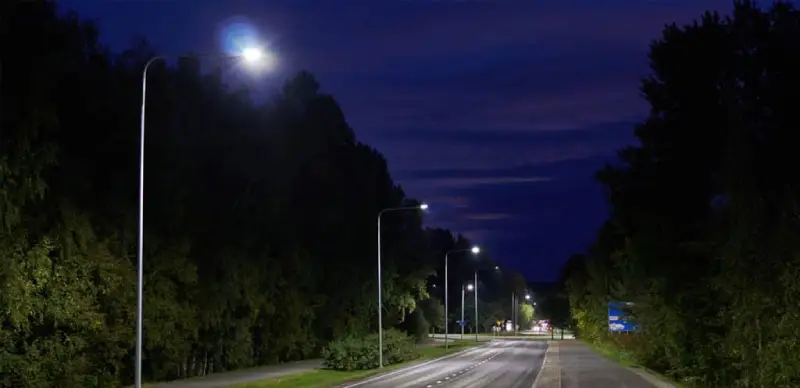
Over the years, LED lighting has developed rapidly, and many manufacturers have successively produced high-power LED street lights, which have been increasingly used in road lighting as energy-saving products. Various countries and organizations are also formulating their own market accessing standards for LED street lamps. Relatively developed countries and regions have higher standards. The market standards of many countries and regions aim more to protect the development of local enterprises in the future.
All countries hope that their companies will occupy a favorable position in this period of lighting source replacement, so they provide relevant subsidies and protection for their leading companies. This results in many different standards of the LED street lamp market. The products of different countries are not compatible with each other, so each manufacturer produces LED street lights with different standards for different countries. With the rapid development of LED street lights, the competition among various companies is quite fierce. Every company wants to be the final winner, and every country also wants its own company to succeed. This method will reduce procurement costs but increase trade costs.
Problems in the application of LED street lights
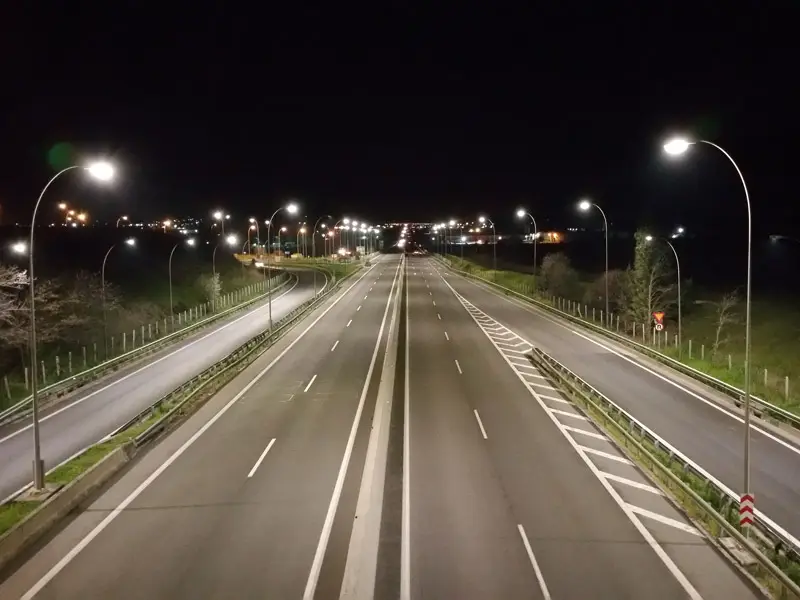
Under the situation of global energy crisis and environmental pressure becoming increasingly prominent, the application of LED light sources in road lighting has become a hot spot in the semiconductor lighting industry in recent years. When LED device products are applied to street lamps, a series of problems such as what are the special requirements for technology, what are the advantages of LED street lamps compared with the current high-pressure sodium traditional street lamps, what are the shortcomings and how to solve are worthy of our serious study.
Standardization and versatility of products are the basis for large-scale use
The current LED street lamps product have a variety of product appearance, arrangement and quantity of LED luminescent particles, external dimensions and internal design of the rectifier circuit. For example: the power of a single tube is different, ranging from 1-5W; the light distribution is different, which are bat-shaped, rectangular, butterfly-wing-shaped, etc.; optical processing methods include those with self-contained lens which can skip secondary optical processing and secondary optical processing ones. There are special drive chip ICs and non electrolytic capacitors for the driver; multi-chip packaging and single-chip packaging for the packaging; the technical circuit has the module, group high-power, chip-integrated high-power, and dot-matrix high-power, etc. There are also two types of power supply assembly with built-in integrated power supply and external power supply, and the heat dissipation technology also has its own advantages, which brings great inconvenience to the operation and maintenance work after universal use, and does not conform to the standardization and generalization design principles of municipal public facilities.
We believe that in the future development process, manufacturers should strictly follow unified standards to ensure that products are safe and reliable in terms of equipment safety and electrical performance. At the same time, LED products used in the field of urban lighting must provide the following guarantees for product standardization and uniformity.
For example: between products in different development stages of the same enterprise, it is necessary to ensure the standardization and uniformity of the main electrical components to avoid the lack of spare parts due to product update and replacement; for products of different enterprises, main electrical components such as the main body of lamps, luminescent particle boards and the rectifier circuit must be based on relevant standards to achieve the necessary standardization and uniformity.
The corresponding international standards are the guarantee for the healthy development of the LED street lamp market
The photoelectric and thermal characteristics of LEDs are very different from traditional light sources, which makes it impossible to completely apply the measurement methods of traditional lighting sources to the measurement of existing LEDs. At present, LEDs lack appropriate standards in terms of product specifications and measurements, resulting in a wide variety of products, a lack of standards for measurement and irregular markets. The diversity of products also makes it impossible for enterprises to produce on large-scale. It has become an urgent need for the industry to formulate relevant LED standards. Relevant enterprises should carry out new market positioning and product planning, seize new opportunities, and adopt necessary quality assurance measures.
Optical design and heat dissipation are the main technical problems faced by LED street lamps
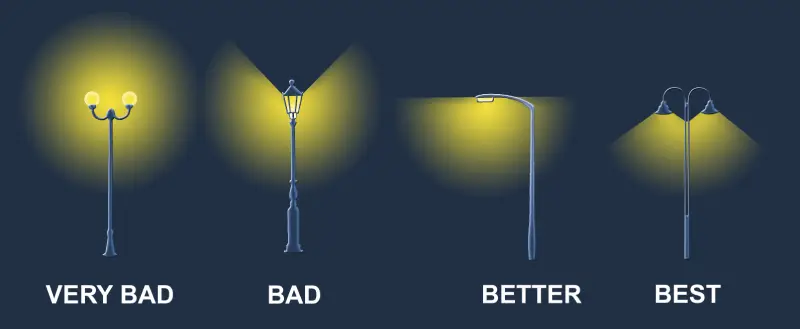
Although the development of high-power LED street lamps is fast, there are still varying degrees of low watts and lumens, low-level handling of secondary luminous efficiency, low system luminous efficiency, fast light decay, short lifespan, and color temperature deviation, different light colors, multiple faults in the driver and a series of problems. Among them, the main technical issues such as secondary optical design, heat dissipation design and power regulator system design are the key to improve luminous efficiency and prolonging lamps’ life.
To give full play to the strengths of semiconductor light sources, the design of the secondary optical system of LEDs is crucial to the light distribution and optical output efficiency of LED street lights. Good road lighting requires the light distribution of LED street lights to be a rectangular light pattern. All the light emitted by the street lights can just cover the road, so that the light pollution outside the road is almost zero. Dr. Jiang Jinbo from the Hong Kong Polytechnic University introduced two light distribution designs for LED street lamps: the first LED street lamp uses an axisymmetric total reflection lens or reflective cup, and the LED lens modules are arranged on a curved surface to produce a rectangular light distribution. The introduction of total reflection lens can greatly improve the utilization efficiency of light, but the arrangement of curved LED modules makes the heat dissipation design and mechanical structure of high-power LEDs more complex. The second type of LED street light adopts lens with asymmetric free curved surface, which can directly complete the rectangular light distribution by a single LED optical element. The overall lamp holder only needs to simply arrange the LED modules with rectangular light distribution on a flat plate. This kind of LED street lamp is relatively simple in terms of mechanical structure, heat dissipation and power control. It only needs to add different numbers of LED modules for road lighting of different grades of roads and different pole heights. The use of asymmetric free curved surface secondary optical elements can make the rectangular light distribution of LED street lamps directly realized with a single LED module. The overall street lamp only needs to arrange these LED module arrays in the same direction, which can simplify the design of street lamp mechanism, heat dissipation and controlling power supply.
A light distributor suitable for the packaged light source should be developed to make more reasonable and full use of the light emitted by the light source, so as to improve the light output efficiency of the entire lamp. At present, the radiation forms of LEDs include Lambertian, side-firing, bat-wing, rectangular, butterfly-wing and spotlighting. Through the secondary optical design, the illumination range and photometric curve of the LED meet the needs of road lighting.
LEDs are embedded in lighting fixtures. Due to the high heat generation of LED chips, the key technology when making high-power lamps is “heat dissipation”. Although the luminous efficiency is getting higher and higher, the heat generated by the LED chip is still very large. Every time the junction temperature of the PN junction increases by 10 degrees, the life of the semiconductor device will be reduced by 1 times. The high temperature of the LED chip leads to the deterioration of the chip itself and the performance of the packaging resin, which eventually leads to a reduction in luminous efficiency and a shortened life. At present, each manufactor has adopted different heat dissipation measures, most of which adopt an integral and systematic heat dissipation design concept and apply high-performance heat-conducting materials such as aluminum die-casting mold, aluminum extruded toothed heat sink, integral toothed heat sink, aluminum extruded profile row toothed heat sink, long-fin form heat pipe, external toothed structure sheet, natural convection fluid heat dissipation, etc. Some also use a combination of super alloy heat pipe (the heat conduction speed of which is 100 times faster than that of pure copper) and high-density heat dissipation aluminum fins. The heat generated by the chip is quickly converted from a point source to a line source, so that the heat is evenly distributed to the heat sink. The heat sink are downward to avoid the accumulation of dust and bird droppings. Factors such as chip packaging and heat dissipation of lamps may cause light attenuation.
Price is still the biggest obstacle to the large-scale application of LED street lamps
At present, the cost of LED street lamps is still far higher than that of high-pressure sodium lamps. The price of an LED street lamp is 4,000-8,000 yuan, or even higher, while the price of a set of imported high-pressure sodium lamps (including lamps and complete sets of electrical light sources) does not exceed 1,500 yuan. As far as the status quo is concerned, LED street lamps are obviously too expensive with a price 3-5 times higher than that of high-pressure sodium lamps. Therefore, even though the power consumption of LED street lamps is only one-third of that of high-pressure sodium lamps, the cost recovery period of replacing high-pressure sodium lamps with LED street lamps will still be long because the price is much higher than that of high-pressure sodium lamps.
Table 1:Comparison of Power LEDs and Traditional Road Lighting Sources
| high-pressure sodium lamps | Metal halide lamp | LED light | |
| power | 250W/400W | 150W | 10-90W |
| lifespan | 24000h | 10000-15000h | 50000-100000h |
| color | yellow | white | white |
| Color rendering | 20-40 | 60-80 | 70-90 |
| Luminous efficiency | 130lm/W | 100lm/W | 100lm/W |
| Color temperature | 2700K | 3000K | 3000-4500K |
| Whether the color temperature is adjustable | no | no | yes |
| Volume of light source | big | medium | small |
| cost | low | medium | high |
Therefore, price and cost are still the biggest obstacles for LED street lamps to be officially promoted in the road lighting market. To acheive a lower price of LED street lamps to compete with existing lamps, the cost of each manufacturer needs to be reduced. But in the near future, it can only make up for the disadvantages of cost through the advantages of life and energy saving of LEDs under the premise that LED technology continues to mature and luminous efficiency continues to improve.
epilogue
Compared with traditional street light sources, LED street lights have many advantages, but there are still some key technical problems that need to be solved urgently, and a lot of work needs to be done in development, research and promotion. We hope that LED street lights will continue to improve, and in the near future, they will be more widely used in the construction of urban lighting with excellent performance.